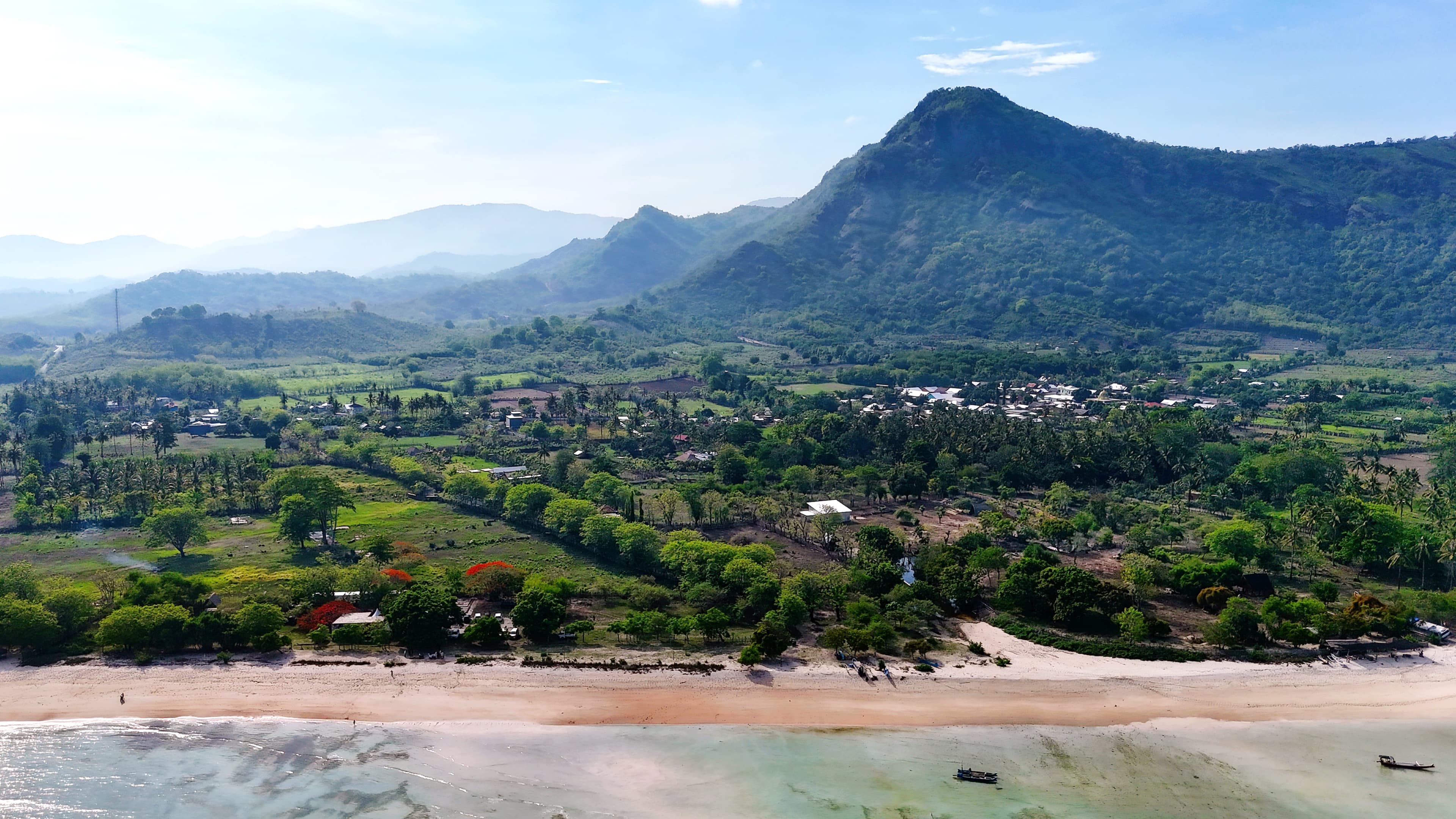
Land Banking in Indonesia. Legal Rules, Risks and Foreign Ownership
Land banking in Indonesia means buying land to hold for future sale or development ...
5 min read
18.09.2026
Land banking in Indonesia means buying land to hold for future sale or development ...

What should you check before buying land in Indonesia? ...

Hak Guna Bangunan literally means the Right to Build ...

Data-based overview of West Sumbawa for land investors ...
It now depends on where a foreigner can still legally enter. As of 13 May 2026, Bali blocked new low-risk real estate KBLI activations for foreign-owned companies (PT PMA) in the OSS system — new foreign land acquisition there now relies on workaround structures.
Lombok is open but land prices have already risen significantly following the Mandalika development. Frontier regions like Sumbawa carry no such restrictions and remain at an early stage of investment development.
Sumbawa is where a foreigner can still take a clean, registered land position today — under HGB title via PT PMA (rare even in Lombok, which is leasehold-led), at land prices roughly ten times lower than Bali.
Learn more about the region → West Sumbawa: A Regional Overview
Yes, buying land in Sumbawa can be an excellent investment. West Sumbawa suits investors positioning ahead of infrastructure activation, not those seeking rental income or near-term liquidity. Three factors define the case:
– Coastal land at $10–50/m² sits well below comparable markets (South Lombok $100–250/m², Bali $600–1,000+/m²), reflecting an earlier point in the development cycle.
– Kiantar Airport is built and permitted, with scheduled commercial flights from Bali anticipated — not contracted — in mid-2027.
– Premium frontline supply near Scar Reef, Super Suck and Yoyo's is limited. The trade-offs are equally concrete: low liquidity, a thin secondary market, and a holding period measured in years, not months.
Foreign buyers hold through HGB via a PT PMA, under an active-use obligation that makes documented development or use — not passive holding — the compliant path. This is a land-value position with a 5–10 year horizon, not a yield or short-term play.
Land prices in Sumbawa are driven upward primarily because coastal land remains deeply undervalued compared to Bali and Lombok, creating a massive price gap that is aggressively closing due to the completion of the new West Sumbawa Airport and the shrinking supply of premium beachfront near elite surf spots.
The core drivers of property value growth include:
The Low Entry Price Gap: Beachfront and cliff-front plots in West Sumbawa are priced at a fraction of saturated markets, offering investors maximum leverage for capital appreciation as prices inevitably catch up to regional standards.
The Airport Infrastructure: With Kiantar Airport already built, the upcoming launch of direct flights from Jakarta and Bali removes the final barrier to accessibility, historically triggering rapid price spikes in Indonesian real estate.
Proximity to World-Class Surf: The scarce supply of flat, developable frontline land directly facing legendary surf breaks like Scar Reef, Super Suck, and Yoyo's (Sekongkang) is creating a highly competitive seller's market as boutique luxury developers lock down prime plots.
Yes — land banking can be a sound long-term investment in Indonesia, but only when structured for compliance and a multi-year horizon. It is not a passive or guaranteed strategy, and it suits investors positioning ahead of infrastructure activation rather than those seeking rental income or near-term liquidity.
Three factors define whether it works in a region like West Sumbawa:
Entry point: Coastal land trades well below comparable markets such as South Lombok and Bali, reflecting an earlier stage of the development cycle. The timing and scale of any appreciation vary by parcel and are not guaranteed.
Holding obligations: Raw land carries low operational overhead, but Indonesian law does not permit indefinite passive holding. Under PP 20/2021, land left unused for its designated purpose can be classified as abandoned (tanah terlantar) and become subject to state reclamation. Compliant holding requires documented use or development within the period set by the title and regulation — a real cost to plan for, not a zero-cost position.
Exit: Routes include a whole-parcel sale, subdivision into individually registered lots, or transfer of the PT PMA that holds the land. Liquidity is low and the secondary market is thin, so exit depends on demand and should be defined before acquisition.
Foreign investors hold through HGB via a PT PMA. With proper legal structuring and independent due diligence, land banking here fits a 5–10 year horizon — not a short-term or speculative play.
Yes. But foreigners cannot own freehold land (Hak Milik) in their own name. Freehold title is reserved for Indonesian citizens.
Foreign buyers usually acquire land in one of two ways: through HGB held by a foreign-owned Indonesian company (PT PMA), or through a long-term leasehold agreement with the landowner. With HGB, the land right is registered in the company’s name. With leasehold, the land remains in the owner’s name and the buyer receives the right to use it for an agreed term.
Nominee arrangements are not legal ownership and should never be treated as a substitute for a proper land title or lease agreement.
Neither is automatically better. HGB is usually the better option for a business, development project or a buyer who wants a registered land right through a PT PMA. Leasehold is usually simpler for someone who wants long-term use of land without setting up a company.
Indonesian law does not set a numerical maximum term for a Hak Sewa lease. An 80-year lease can be agreed in one contract in Bali, Sumbawa or elsewhere in Indonesia if the owner accepts it.
The 25–30-year leases common in Bali are not a legal limit. They are a market practice: many owners prefer a shorter term so they can renegotiate at a higher price later. A lease should clearly state the full term, payment, transfer rights and what happens if the owner dies or sells the land.
Before paying, ask for the current land certificate, an official BPN certificate check, the seller’s identification and any required consent from a spouse, co-owner or heir. You should also verify the plot boundaries, legal road access and zoning.
For an HGB transaction, you should receive the PPAT transfer deed, tax receipts, proof of BPN registration and the final HGB certificate in your PT PMA’s name.
For a leasehold transaction, you should receive the signed lease agreement, a copy of the owner’s land certificate and clauses that protect you if the owner dies or sells the land.
The main risks are a disputed or encumbered certificate, a seller who has no legal authority to transfer the land, no legal road access, or zoning that does not allow the intended use. A nominee arrangement does not give a foreign buyer registered ownership.
Before paying, check the certificate with BPN, confirm the seller’s authority and any required consents, and verify the plot boundaries, access and zoning. For a transfer of registered land rights, use a PPAT and independent legal due diligence.
For an HGB or other land-right transfer, the buyer normally pays BPHTB, a local acquisition tax of up to 5% of the taxable value after the local allowance. The seller normally pays final income tax of 2.5% of the gross transfer value. VAT may also apply where the seller is a VAT-registered business.
Buyers should also budget for PPAT or notary fees, BPN registration and certificate checks, legal due diligence, and, where relevant, PT PMA setup and compliance costs.
Leasehold is different: no BPHTB is due, but the landlord’s rental income is generally subject to 10% final tax. The lease should state whether the agreed rent is gross or net of that tax.
Before buying land in Indonesia, verify the land certificate, the seller’s authority to transfer it, and whether the plot is free from disputes, mortgages, blocks or court claims. You should also confirm zoning, plot boundaries, legal road access and whether the land can be used for your planned project.
For leasehold land, the agreement must clearly protect the buyer’s rights if the owner dies, sells the land or defaults.
Sumbawa Property Trust provides each buyer with the ownership documents, zoning context, parcel boundaries, access information and supporting materials needed for legal due diligence. Final legal verification should still be completed by an independent lawyer and PPAT.
Check the applicable spatial plan—RDTR or RTR—and confirm whether the intended use is permitted on the exact coordinates of the land. For a business or development project, the relevant spatial conformity approval, known as KKPR, should match the planned use, such as a villa, hotel, restaurant or resort.
A “tourism area” label alone is not enough. The plot, project type and building parameters must all comply with the applicable zoning rules.
All land listed by Sumbawa Property Trust is located in tourism-zoned areas. We provide zoning information before the purchase process begins, while final project approvals must be obtained for the buyer’s specific development.
This depends on the coastal setback line, zoning and the type of structure. Permanent buildings are generally subject to the Garis Sempadan Pantai coastal setback, measured from the highest tide line. Some non-permanent, low-impact structures may be allowed closer to the shore, subject to local planning rules and project approval.
Sumbawa Property Trust can assess a specific plot and help determine what type of development can be permitted before you commit to a purchase.
Do not rely on a road that is merely visible on site or on a map. Before buying, you should receive written confirmation that the plot has lawful access from a public road or through an established access route.
For every Sumbawa Property Trust listing, we provide a letter from the village administration confirming legal access to the plot. At the buyer’s request, this document can be notarised as part of the transaction file.
Required permits depend on the land, zoning and project scale. A development may require spatial-use approval (KKPR), building approval (PBG), environmental approval such as AMDAL or UKL-UPL, an NIB and sector-specific operating licenses. An SLF is generally required before a completed building can be used.
Sumbawa Property Trust can support the full permitting process required for your project, from zoning and company setup to construction and operating approvals.
Land in West Sumbawa typically ranges from $10 to $15 per square meter for ocean-view and hillside parcels, and roughly $25 to $50 per square meter for beachfront in the Jelenga area. That is about $100,000 to $500,000 per hectare; large parcels are priced lower per square meter at scale — a 50-hectare ocean-view parcel sits at around $4 million. These levels remain well below comparable coastal land in South Lombok ($100–250/m²) and Bali ($600–1,000+/m²).
West Sumbawa beachfront currently trades at roughly $25–50 per square meter in the Jelenga area, compared with $100–250 in South Lombok and $600–1,000+ in Bali. Premium West Sumbawa corridors such as Kertasari already reach $50–150/m². The gap to Lombok and Bali reflects West Sumbawa's earlier position in the development cycle — the same drivers now present here (Kiantar Airport and PT Amman Mineral investment) preceded earlier price growth in those markets.
SPT offers verified plots from 0.5 to 5 hectares for individual investors, and larger contiguous parcels of 10, 25, and up to 50+ hectares for large-scale and institutional acquisition. The minimum plot size is 0.5 hectares (5,000 m²). Adjacent plots can be combined, and larger parcels can be subdivided into individual lots.
West Sumbawa is currently reached via Lombok International Airport (LOP), followed by a ferry from Kayangan to Poto Tano and a road transfer — about 6 hours total from Bali. Three private charter flights per week already operate between Jakarta and Kiantar Airport near Poto Tano. From mid-2027, scheduled commercial flights from Bali are anticipated (Wings Air and TransNusa), which would cut total transit to roughly 2 hours.
Kiantar Airport received its operating permit on 21 October 2025 and passed runway calibration in November 2025. As of early 2026, three weekly private charter flights operate between Jakarta and Kiantar; these are not yet scheduled commercial routes. Scheduled commercial passenger service from Bali is anticipated in mid-2027 via Wings Air and TransNusa on ATR 72-class aircraft — anticipated, not contracted, with realistic variance. Kiantar is currently a special-purpose airport (bandara khusus), not an international airport.
Kiantar Airport is the primary catalyst in the West Sumbawa land thesis, based on a clear regional precedent rather than speculation. After Lombok International Airport opened in 2011, beachfront and near-beach land in newly accessible South Lombok submarkets rose an estimated 300–500% over the following 36 months (industry-cited, wide variance by parcel). Indonesian precedent suggests the largest price step-up follows the launch of commercial flights, not the completion of infrastructure — placing West Sumbawa in a pre-commercial window ahead of the anticipated mid-2027 service. This is a documented pattern, not a guaranteed outcome.
West Sumbawa is in an active infrastructure build-out phase across transport, utilities, and industry. The Maluk–Poto Tano highway is complete, the regional power grid is being extended to coastal areas, and the SPAM Bintang Bano regional water system supplies surrounding settlements. Mobile coverage now reaches 5G in key areas under the Digital NTB program. The region is also anchored by PT Amman Mineral Nusa Tenggara — operator of the Batu Hijau copper-gold mine and a ~$1.4B smelter — alongside a growing cluster of eco-resorts and master-planned coastal developments.
Budget for taxes, registration and professional fees. The buyer normally pays BPHTB, a local acquisition tax of up to 5% of the acquisition value after the local tax-free threshold. The seller normally pays 2.5% final income tax on the transfer value.
You should also budget for PPAT deed fees, BPN registration fees and independent legal due diligence. PPAT fees for the land deed itself cannot exceed 1% of the price stated in the deed. PBB-P2 is separate: it is an annual land-and-building tax, not a closing cost.
The exact total depends on the regency, land value and whether the transaction involves an existing title transfer or a new HGB process.
A PT PMA that owns land normally needs to pay PBB-P2 when the local tax bill falls due, file its annual corporate tax return, and submit investment reports through OSS.
For a calendar-year company, the annual corporate tax return is generally due by 30 April. Medium and large businesses must submit LKPM reports quarterly through OSS, usually by 15 April, 15 July, 15 October and 15 January.
Additional monthly tax filings may apply if the company pays salaries, contractors, rent, dividends or is registered for VAT. No revenue may mean no corporate income tax is due, but it does not remove the company’s reporting obligations.
Use a documented bank trail: overseas shareholder, PT PMA bank account, then seller’s bank account.
The funds should be recorded as share capital or a properly documented shareholder loan before the PT PMA pays the seller. Land payments in Indonesia should normally be made in rupiah under a signed agreement.
Before transferring funds, provide the bank with source-of-funds evidence, the signed agreement, certificate details and payment schedule. Keep all SWIFT confirmations and payment records.
Do not send purchase money to an agent, nominee or unrelated third-party account.
Pay only under a written booking agreement or PPJB that identifies the certificate and plot, recipient bank account, due-diligence period, refund deadline and exact conditions for release of funds.
The deposit should be refundable if due diligence reveals an undisclosed mortgage, block or dispute; the seller cannot prove authority to sell; the boundaries or legal access do not match; the zoning does not allow your stated project; or the agreed leasehold or HGB structure cannot be completed.
Use a traceable bank payment, not cash. Release later payments only when the agreed legal milestones have been completed.
Tax rates, local thresholds and transaction requirements should be confirmed for the exact plot before funds are released.
Land banking is acquiring undeveloped land and holding it for long-term appreciation, rather than developing or renting it for income. In Indonesia it is most common in pre-development coastal and tourism regions where land is still early in the price cycle; foreign investors hold these parcels through a PT PMA under HGB title or via long-term lease (Hak Sewa). The strategy suits a 5–10 year horizon, positioning ahead of infrastructure activation. West Sumbawa is one of Indonesia's clearest current examples — coastal land at $10–50/m² ahead of the anticipated 2027 Kiantar Airport commercial launch.
Yes. A land title in Indonesia can be legally subdivided into smaller parcels through a certificate split (pemecahan sertifikat) registered at the National Land Agency (BPN), with each new lot receiving its own certificate. For foreign-owned land held under HGB through a PT PMA, the company subdivides and can then sell or transfer individual lots separately. Subdivision is the core mechanism behind staged resale, commonly used to convert one large parcel into higher-value smaller plots. In West Sumbawa, SPT subdivides large coastal parcels into individual investor lots and manages the full BPN registration process.
Foreigners sell Indonesian land through the PT PMA that holds it, using one of two routes: a direct transfer of the land to the buyer via notarial deed (AJB), or a sale of the PT PMA company itself through a share transfer, which moves the land asset without re-registering the title. Share sales are common for large, resort, and island-scale transactions because they are faster and can be more tax-efficient. On a direct land sale, the seller pays PPh tax of 2.5% of the transaction value. In West Sumbawa, SPT handles resale end-to-end, including subdivision of large parcels into smaller lots for staged exit.
West Sumbawa fits a land banking strategy because it sits at an early, pre-commercial stage of the development cycle with a clear infrastructure catalyst ahead. Coastal land currently trades at $10–50/m², compared with $100–250/m² in South Lombok and $600–1,000+/m² in Bali, and Kiantar Airport — permitted in October 2025 — is anticipated to begin commercial flights from Bali in mid-2027. Regional precedent is relevant: after Lombok's airport opened in 2011, accessible beachfront rose an estimated 300–500% over the following three years. The main trade-offs are low liquidity and a thin secondary market, which is why land banking here suits a 5–10 year horizon rather than a short-term hold.
Family offices use land in Southeast Asia as a long-term, asset-backed investment outside public markets. The strongest opportunities are usually found in early-stage tourism and infrastructure regions where land prices remain low but accessibility, utilities and development activity are improving.
The strategy offers several possible exits: holding the land for appreciation, selling the entire parcel, subdividing it into smaller lots or partnering with a developer. The main limitations are low liquidity, long holding periods and the need for strict legal and commercial due diligence.
Explore strategic land investment opportunities in West Sumbawa →
A foreign fund cannot directly own Indonesian freehold land under Hak Milik. Institutional investors normally acquire land through an Indonesian foreign-owned company, or PT PMA, which can hold a registered Hak Guna Bangunan title when the ownership structure, licences and intended land use comply with Indonesian law.
HGB is generally the preferred structure for land banking, development and commercial projects. A long-term lease is also possible, but it provides contractual use rights rather than a registered land title.
Learn how foreign land ownership and HGB work in Indonesia →
Investors should verify the land certificate, the seller’s authority, zoning, legal access, boundaries and any mortgages, disputes or inheritance claims. Large acquisitions may involve several owners or certificates, so every parcel must be checked separately.
Commercial due diligence should also assess topography, utilities, coastal setbacks, construction access, infrastructure plans and realistic exit demand. The purchase agreement should define payment stages, deposit protection, transfer conditions, taxes and the process for consolidating or subdividing the land.
The main exit routes are selling the entire parcel, subdividing it into smaller registered lots, transferring the company that holds the land or partnering with a developer.
A whole-parcel sale is usually simpler but depends on demand from another large buyer. Subdivision can expand the buyer pool and increase the price per square meter, but requires surveying, certificate splitting, infrastructure planning and additional time. A company sale or joint venture may be more suitable for large development-ready assets.
The exit strategy should be defined before acquisition because it affects the appropriate title, parcel size, legal structure and holding period.


Land-use concept and investment feasibility assessment included with your purchase