West Sumbawa, Indonesia: Economy, Infrastructure and Investment Outlook
20 min read
West Sumbawa: Economy, Infrastructure & Investment Outlook
September 19.09.2026, 15:15
West Sumbawa brings together the Batu Hijau copper-gold complex, agricultural and fishing communities, the Poto Tano ferry gateway, and a southern coastline shaped by surf tourism around Sekongkang and Jelenga.
The regency occupies the western end of Sumbawa Island in West Nusa Tenggara. Established in 2003 with Taliwang as its capital, it has developed around mining, mineral processing, public infrastructure and a coastal tourism sector that is still taking shape.
This overview examines the forces shaping West Sumbawa today: its economy, population, transport links, public projects and emerging development areas. It also separates completed infrastructure from announced plans, using official statistics, government records and corporate disclosures.
Geography and Administrative Context
West Sumbawa occupies roughly the western quarter of Sumbawa Island. To its west lies the Alas Strait and, beyond it, Lombok — connected by ferry through the port of Poto Tano on the regency's northwestern coast. To the east, it borders the larger Kabupaten Sumbawa.
The capital, Taliwang, sits inland on the western flank of the island. Other significant settlements include:
Maluk and Sekongkang — the southwestern coastal area where the Batu Hijau mine operates. Both have grown considerably since the 1990s alongside mining activity.
Jereweh — a coastal sub-district that includes the Jelenga area, increasingly recognised among surfers for the breaks at Scar Reef, Super Suck, and Yoyo's.
Brang Rea and Brang Ene — inland sub-districts where the regency's two major dam projects are located.
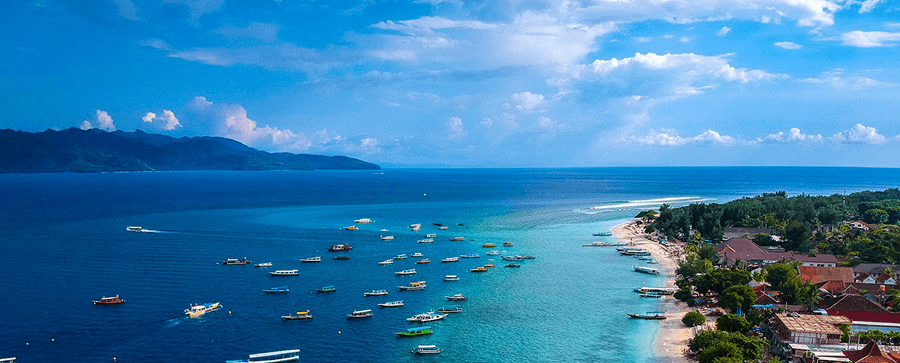
Poto Tano — the ferry port and a national logistics chokepoint connecting Sumbawa to Lombok.
Administratively, the regency is divided into eight kecamatan (sub-districts). It covers approximately 1,849 square kilometres, with a population density of around 79 people per square kilometre as of 2024 — well below the national average and reflective of the region's largely rural character.
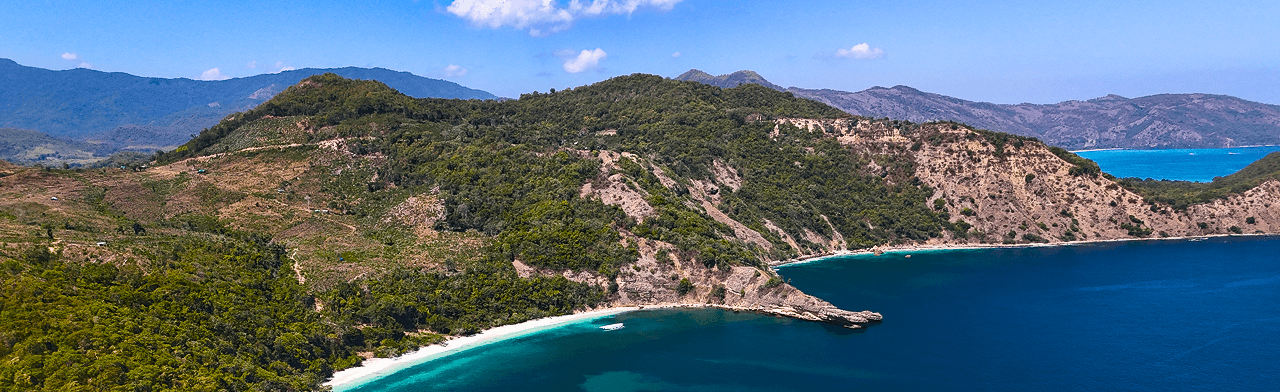
The terrain is mixed. Coastal lowlands give way to hills inland, and the southern and western coasts are punctuated by reef systems that produce the surf breaks the region has become known for among long-haul travellers.
"West Sumbawa Regency within West Nusa Tenggara, Indonesia."
Demographics
Population
The 2020 national census recorded a population of 145,798 in West Sumbawa, split roughly evenly between men (73,687) and women (72,111). For comparison, the 2010 census had recorded 114,951 residents — a gain of just over thirty thousand people in a decade.
That growth rate, averaging around 2.4 per cent per year between 2010 and 2020, is faster than the average for West Nusa Tenggara as a whole. In the preceding decade (2000–2010), the rate was even higher — approximately 3.2 per cent annually, well above the provincial mean.
What drove the growth
The acceleration in the 2000s coincided with the operational ramp-up of the Batu Hijau coppergold mine, which began commercial production in 2000. The mine drew workers not only into direct mining employment but into a wider ecosystem of contractors, food services, transport, and housing — pulling migrants from elsewhere in NTB and from other Indonesian provinces.
Migration has slowed somewhat since the early 2010s, but it remains a meaningful factor — particularly when major project phases come online. The opening of the new copper smelter in 2024 (discussed in section 3) is one such phase.
Age structure
The 2020 census paints a relatively young population:
Approximately 30 per cent of residents are under fifteen (43,892 people)
Roughly 65 per cent are of working age, fifteen to fifty-nine (94,991 people)
Only 4–5 per cent are sixty-five or older (6,915 people)
The implication is a high share of working-age and rising-into-working-age population — a demographic profile common to fast-growing Southeast Asian frontier regions, and one that typically supports both labour supply and consumption growth over the next two decades.
Density and gender balance
Population density rose from around 54 people per square kilometre in 2008 to 62 per square kilometre by 2010, and has continued to climb. Gender balance is even, with roughly 102 men for every 100 women.
"Age distribution, West Sumbawa, 2020 (Source: BPS)."
Economy
West Sumbawa's economy is shaped — almost defined — by mining. Understanding the regency requires understanding that single fact, and then understanding what is being done to broaden the base around it.
The mining anchor
The Batu Hijau copper-gold mine, located in Sekongkang sub-district, is operated by PT Amman Mineral Nusa Tenggara (AMNT), formerly PT Newmont Nusa Tenggara. It is one of the largest mining operations in Indonesia.
The mining and quarrying sector accounted for roughly 81.9 per cent of the regency's gross regional product (GRP) in 2021. Across 2018–2022, the sector's contribution ranged between 76 and 86 per cent of GRP. AMNT's output is the single largest line item in that figure.
This concentration produces volatility. When mining output contracted in 2011 and 2012, regional GRP fell by 28.2 per cent and 26.3 per cent respectively. When a new phase of pit development came online in 2015, GRP expanded by 107 per cent in a single year. These swings reflect the mechanics of an extractive economy more than any underlying instability — but they are real, and they explain why both the regional government and AMNT itself have prioritised broadening the economic base.
The 2024 copper smelter
In September 2024, President Joko Widodo inaugurated AMNT's new copper smelter and precious-metals refinery, built on a 150-hectare site approximately 1.5 kilometres from Benete port, adjacent to the existing mine. Total project investment is approximately USD 1.4 billion (around Rp 22.9 trillion). The facility is part of Indonesia's national downstreaming policy — the strategic shift away from exporting raw concentrate toward processing minerals domestically.
The smelter is designed to process 900,000 tonnes of copper concentrate per year, drawing feedstock from Batu Hijau and the prospective Elang deposit. At full capacity, annual output is expected to include:
Approximately 222,000 tonnes of cathode copper at LME Grade A purity (99.99 per cent)
Around 830,000 tonnes of sulphuric acid (industrial by-product)
Up to 18 tonnes of gold, 55 tonnes of silver, and 77 tonnes of selenium, refined from anode slimes
Production began in stages: the first copper anode was produced in February 2025, and the first cathodes in late March 2025. As of mid-2025, smelter output was reported at approximately 35 per cent of design capacity, with full ramp-up ongoing through 2026 as the company progresses through its commissioning phase.
The economic significance is twofold. First, the smelter retains in-region value-added that previously left the country embedded in raw concentrate. Second, it deepens the industrial base — adding refining and processing employment to extractive employment, alongside a substantial increase in tax and royalty receipts to the local budget.
"PT AMMAN copper smelter, inaugurated September 2024."
Agriculture and fisheries
Outside mining, the most established sector is agriculture. Rice and maize are the principal crops, grown predominantly in the inland valleys around Brang Rea and Brang Ene where irrigation systems have expanded following the completion of the Bintang Bano and Tiu Suntuk dams. Cattle are raised on upland pastures — Sumbawa cattle are a recognised regional breed — and the island has a long-standing tradition of honey production.
Coastal communities engage in fishing and seaweed cultivation. Despite this diversity, agriculture's share of regional GRP is modest, estimated at under 10 per cent. Its importance lies more in food security and household-level income than in macroeconomic terms.
Trade and small business
Small enterprise is the de facto employer for a large share of the population. As of 2016, the regency hosted more than 2,225 small shops (kios) and six traditional markets, with around 37 per cent of economically active residents classified as self-employed or operating microbusinesses.
Trade activity tracks the broader economy closely. During mining-cycle peaks, small businesses serving mineworker households expanded; during downturns, they contracted. The trade and transport sectors have been identified by the regional government as priority areas for diversification, given Sumbawa's position on the Lombok-to-eastern-Indonesia logistics corridor.
Tourism
Tourism is at an early stage of development in West Sumbawa. The region's draw is specific rather than mass-market: surf breaks at Maluk, Yoyo's, Scar Reef, and Super Suck are internationally recognised among advanced surfers; the inland village of Mantar is known for its hilltop views; and the Poto Tano archipelago offers small-island marine tourism.
The local government and provincial authorities have been candid that supporting tourism infrastructure — paved access roads, water supply, accommodation — remains incomplete in coastal areas outside the main urban centres. Provincial road priorities are now shifting toward tourism-access routes following the completion of the main logistics corridors. Private investor interest in the Jelenga–Jereweh coastal zone has been reported in 2025, with proposals for resort development referenced in regional press.
Wealth ranking
In its 2024 review of regional fiscal performance, BPS placed West Sumbawa among the fifteen wealthiest regencies in Indonesia by GRP per capita. The ranking is heavily influenced by mining sector contributions, but it nonetheless reflects a level of fiscal capacity unusual for a relatively young and predominantly rural kabupaten.
The state of infrastructure in West Sumbawa has changed materially in the last five years, and several major projects have either come online recently or are scheduled to do so before 2028. This section covers what currently exists and what is under construction or commissioning.
Water
Water has been a central focus of public investment. Two major dam projects anchor the regency's water security strategy.
Bintang Bano Dam, in Brang Rea sub-district, was inaugurated by President Joko Widodo in January 2022. It has a storage capacity of 76 million cubic metres and a reservoir surface area of 256 hectares. The dam was built at a cost of approximately Rp 1.44 trillion, financed through the Ministry of Public Works (PUPR), and supports a 50-kilometre irrigation network running from Bangkat Monte village toward Poto Tano.
Tiu Suntuk Dam, in Brang Ene sub-district, was inaugurated by President Joko Widodo on 2 May 2024. With a storage capacity of 60.8 million cubic metres — making it one of NTB's largest reservoirs — and a reservoir surface area of 312 hectares, the dam was built at a cost of approximately Rp 1.4 trillion. It is designed to irrigate around 1,900 hectares of farmland across Brang Ene, Taliwang, and Jereweh, supply 680 litres per second of raw water, and reduce flood risk in surrounding areas. Construction of the dam's full irrigation network is scheduled to begin in 2027, with the regency government working with PUPR on technical planning to extend service to additional farmland in the longer term
Drinking water distribution has expanded in parallel. The first phase of the SPAM Bintang Bano drinking water system was commissioned in January 2025, at a cost of approximately Rp 83.9 billion. Phase one delivers 100 litres per second of treated water and includes a 2,000 cubic metre reservoir; a second phase is planned to bring total capacity to 200 litres per second. In addition, Tiu Suntuk Dam alone supplies up to 68 litres per second of raw water, expanding the regency's overall water security envelope substantially.
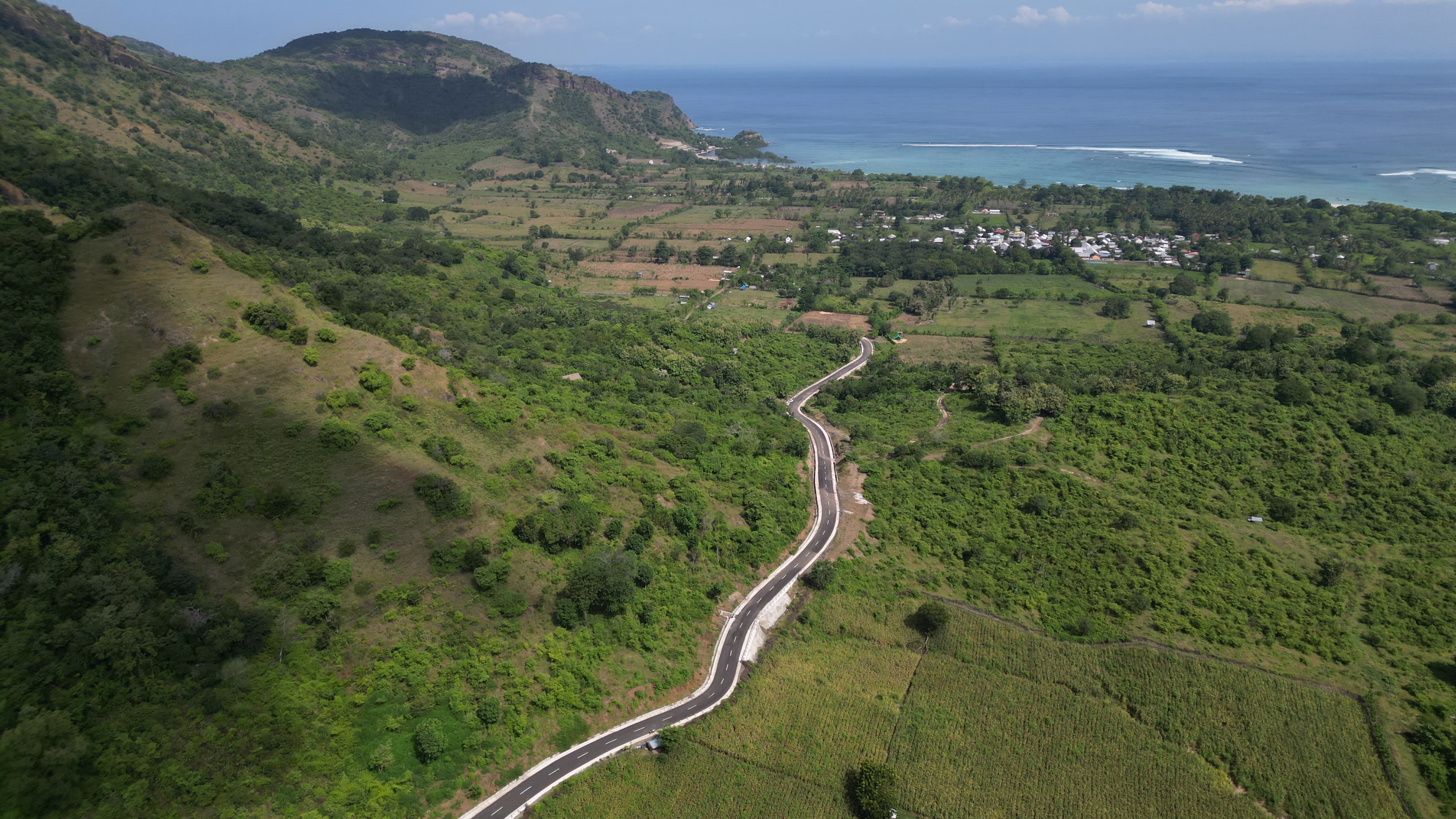
"Road connecting Taliwang and Jelenga Village. Photographed in 2026."
Roads
The regency's primary logistics corridor — the route connecting Poto Tano ferry port to the main island network — was the subject of a major reconstruction in 2025. The Simpang Poto-Tano section, approximately four kilometres long, had been chronically affected by seasonal flooding. The Rp 32 billion project rebuilt the road surface, drainage, and lighting. The Governor of NTB formally reopened the route in January 2026.
This corridor matters beyond West Sumbawa itself. It is a national logistics link, carrying freight between Sumbawa, Lombok, and the broader eastern-Indonesia trade route.
Inland and southern road networks have received substantial investment as well. Roughly Rp 320 billion has been allocated to road and bridge work across southern Sumbawa under presidential infrastructure programmes. The Marente bridge was completed in 2023, and rehabilitation of secondary networks has continued through 2024–2025. Provincial authorities have stated that the next priority, following the completion of arterial routes, is roads connecting tourism sites and outer rural villages.
Power and electrification
Mainline electrification is in place across populated areas, with grid extensions to more remote coastal locations being delivered through regional government programmes funded for 2025–2026.
A 6.3-megawatt mini-hydro plant is in development on the Bintang Bano dam under a publicprivate partnershipstructure (see section 6). The project is expected to add baseload renewable capacity dedicated to local distribution.
Internet and connectivity
Internet coverage is more advanced than the regency's remoteness might suggest. According to a 2022 survey conducted in the mining-area sub-districts:
68.3 per cent of residents aged fifteen and over had used the internet within the previous three months — higher than the NTB provincial average (52.3 per cent) and close to the national average (62.1 per cent)
79–82 per cent of users rated connection quality as good
All major Indonesian carriers operate base stations in the populated areas, providing 4G service
Coverage gaps remain in mountainous interior villages and on the offshore islands of Poto Tano. The provincial Digital NTB programme has set a target of 100 per cent coverage by 2028, working with carriers on tower densification and satellite backhaul where economical.
Air connectivity
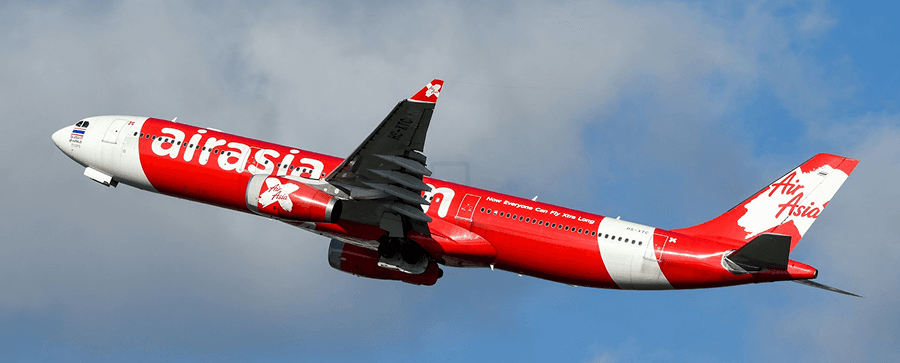
Sumbawa Island is currently served by Sumbawa BesarAirport (WADS) on the eastern side of the island, approximately three and a half hours by road from the Jelenga area. Domestic carriers operate scheduled regional flights from Sumbawa Besar to Lombok and Bali
The most consequential change in the regency's connectivity profile is the development of KiantarAirport, located in Kiantar village, Poto Tano sub-district — approximately a fortyminute drive from the Jelenga area. The airport isa privately developed facility (bandara khusus) commissioned by PTAmman Mineral Nusa Tenggara, with the regional government as a supporting partner.
The 1,500-metre runway is suitable for regional turboprop aircraft such as the ATR 72. The site covers approximately 100 hectares. Total project cost is reported at around Rp 390 billion (approximately USD 25 million). Major construction works — including ground improvement on the runway, taxiway, and apron, completed by international engineering specialists in 2025 — are now finished.
As of early 2026, the airport had not yet commenced regular commercial passenger operations, with no public schedule confirmed by aviation authorities. Local government officials have indicated that the facility will support both private mining-related operations and commercial passenger service once licensed, with anticipated routes from Jakarta and Bali subject to airline confirmation. A direct flight from Bali, when service begins, would shorten total transit time from approximately six hours (via Lombok ferry and road) to under one hour.
"Kiantar Airport near Poto Tano. Regular public passenger services and their launch date have not been officially confirmed.."
West Sumbawa benefits from public investment at three levels — national, provincial, and regency — and several programmes are worth highlighting because they shape both the social fabric and the operating environment for residents and businesses.
Kartu Sumbawa Barat Maju (KSB Maju)
Launched in 2025, KSB Maju is the regency's flagship social programme. It functions as a unified citizen card linked to a household banking account, through which seven categories of public support are delivered:
Education (kindergarten through secondary school enrolment fees, uniforms, university scholarships from 2026)
Healthcare (free ambulance service, transport and accommodation cover for patients referred to hospitals outside the regency)
Social welfare (monthly stipends for orphaned children, recognition payments for community religious figures, funeral assistance)
Small business support (grants, training, equipment distribution)
Housing (subsidies for repair and construction of basic housing for low-income households)
Agriculture (seed and fertiliser distribution, technical training)
By the end of 2025, the majority of households in the regency had received their cards, with full distribution targeted by 2026. As of September 2025, around 9,000 children had received education-related support against a target of 14,000.
KSB Maju is funded primarily from the regency budget with provincial co-financing, and it is one of the more ambitious district-level digital social programmes in eastern Indonesia.
Provincial strategy: NTB Gemilang
At the provincial level, the NTB Gemilang strategy aims to shift the province from primarily resource-based to industrially diversified. The initiative includes outreach to state-owned enterprises and private investors for projects in industrial parks, solar energy, electric mobility, fisheries cold chains, and processing infrastructure. Negotiations with PT Wijaya Karya (WIKA), reported in 2020, are part of this broader effort.
A complementary provincial programme, Zero Waste, is focused on solid waste management and recycling infrastructure, with planned participation from private contractors.
National downstreaming
Indonesia's national policy of downstreaming — keeping mineral processing within the country — has direct effects in West Sumbawa. The 2024 inauguration of the AMNT copper smelter is the clearest example: a private project, supported by tax incentives and export regulation, that retained processing value in the regency. Further downstreaming of secondary metals is part of AMNT's stated strategy.
Public-Private Partnerships
Public-private partnership (PPP) arrangements — known in Indonesia as Kerja Sama Pemerintah dan Badan Usaha (KPBU) — are an increasingly visible feature of the regional development landscape.
The flagship example is the Bintang Bano mini-hydroelectric project. A 6.3-megawatt facility is planned on the existing dam under a Design-Build-Finance-Operate-Maintain-Transfer (DBFOMT) contract structure with a 27-year concession period. Total investment is estimated at around Rp 170 billion. The project is included in Indonesia's national PPP Book, and was at tender stage in early 2024. Investor returns are based on a user-charge mechanism through electricity sales.
Beyond formal PPPs, private participation in regional development takes several forms:
Public procurement — the dominant mechanism. Most road, bridge, and dam construction is delivered by private contractors through competitive tender. The Tiu Suntuk dam, for example, was built by a consortium of PT Nindya Karya and PT PP.
Strategic private investment — the AMNT smelter is the most significant example, supported by national-level incentives.
Corporate social engagement — AMNT operates community programmes including Pertambangan Tanpa Masyarakat Stagnan (loosely, "mining without community stagnation"), which includes reforestation, micro-enterprise support, and education partnerships.
Active investor outreach — provincial leadership has continued to engage state-owned enterprises and private firms across industrial, energy, and tourism sectors.
In 2024, the Ministry of Public Works (PUPR) outlined a target of 34 KPBU projects for the 2025 budget cycle nationally, including 14 water-resource projects and 10 road and bridge projects — with NTB and West Sumbawa featuring in the planning.
Areas of Active Development
No region develops uniformly, and West Sumbawa has clear priorities where work is ongoing. The regional government, provincial authorities, and partner institutions are addressing each through specific programmes. What follows is a candid summary of where the regency is investing and why.
Healthcare
Healthcare provision is centred around RSUD Asy-Syifa, the regency hospital in Taliwang (Class C), supported by a network of eight community health centres (Puskesmas) distributed across the sub-districts. Routine and primary care — immunisation, maternity, common disease management — is well covered.
For specialised care, including complex surgery and oncology, patients are referred to larger facilities in Mataram on Lombok. The KSB Maju programme funds patient transport and accommodation for referred cases, addressing the cost barrier that previously discouraged some households from seeking specialist care. A partnership with the medical faculty at Universitas Mataram (Unram) provides medical scholarships for students from West Sumbawa, with returnof-service arrangements to expand the local specialist base over time.
Notably, child stunting — a persistent challenge across rural Indonesia — has fallen to approximately 7.4 per cent in West Sumbawa as of 2024, one of the lower rates in the province and below the national average. This is the result of sustained investment in WASH infrastructure, nutrition programmes, and the broader healthcare network.
Education
Primary and secondary education is available across all sub-districts, with state schools operating from kindergarten through senior secondary in Taliwang and the larger settlements. There is no university in the regency itself; students seeking tertiary education travel to Mataram or to Java.
The KSB Maju education component addresses cost barriers — covering enrolment fees and uniforms across all levels — and from 2026 will provide university scholarships for students from low-income families. The Universitas Mataram partnership provides additional pathways into medical and technical fields. Quality and capacity in rural schools remain priorities, with continued teacher recruitment and facility upgrades programmed through provincial education budgets.
Banking and financial services
Formal banking infrastructure is concentrated in Taliwang, where Bank NTB Syariah, BRI, BNI, and several rural credit institutions (BPR) maintain branches. In some outer sub-districts, branch presence has historically been limited.
Expansion is underway through several mechanisms:
The KSB Maju programme establishes a household banking account for participating families, dramatically broadening account ownership
Agent banking — partnerships with local shops to provide cash withdrawal, deposit, and bill-payment services — is being expanded into outer areas
Mobile banking services are extending reach into communities without physical branches
Microfinance through Sharia-compliant cooperatives (BMT) and rural credit institutions continues, and the regency's office for cooperatives and SMEs actively works to broaden financial access. Digital and fintech adoption among younger entrepreneurs is rising in step with internet penetration.
Housing
Around 8–10 per cent of households in the regency were classified as living in sub-standard housing in 2021 — that is, dwellings with limited sanitation, dirt floors, or insufficient space. The KSB Maju housing component provides materials and subsidies for repair and construction of basic housing; in 2023, the programme targeted improvement of at least 150 homes. The regency also participates in the national Rusunawa programme, which supports affordable rental housing — a unit for public-sector workers has been completed in Taliwang, with further projects planned under central co-financing.
Secondary roads
While arterial routes have been substantially modernised, the regency's secondary road network — particularly routes serving inland villages, agricultural areas, and tourism sites — remains a focus of ongoing investment. As of 2022, approximately 60 per cent of the network was rated in good condition. Provincial authorities have stated that, with major arterials now complete, secondary network upgrades and tourism-access roads are the next priority.
The pattern in each of these areas is consistent: a known development priority, an identified programme or budget allocation, and measurable progress over the past five years. None of these are static deficits — all are under active management.
Regional Comparisons
West Sumbawa sits within a regional context that is worth understanding for anyone studying the kabupaten in isolation.
Within West Nusa Tenggara province (NTB), the regency is one of ten administrative units. Lombok contains five (Mataram city, West Lombok, Central Lombok, East Lombok, and North Lombok); Sumbawa Island contains four regencies—West Sumbawa, Sumbawa, Dompu and Bima—and one city, Bima. Mataram on Lombok serves as the provincial capital and the principal urban, healthcare, and educational centre.
Compared to the rest of Sumbawa Island, West Sumbawa has higher GRP per capita (driven by mining), better arterial connectivity (because of the Poto Tano ferry link), and a more developed public-services base.
Compared to Lombok, particularly the southern coast around the Mandalika Special Economic Zone, West Sumbawa is at an earlier stage of tourism and real-estate development. South Lombok has had a major international airport since 2011 and the Mandalika MotoGP circuit since 2021, both of which have attracted substantial private investment and accelerated land-market activity.
Compared with Sumba, located southeast of Sumbawa in East Nusa Tenggara, West Sumbawa has a more mining-dependent economy, while Sumba has developed a stronger international profile in high-end tourism. Both remain less mature tourism markets than South Lombok, but their economic structures and development paths are different.
Lombok, Sumbawa and Sumba illustrate different regional development models. Infrastructure, anchor investments and tourism visibility can influence growth, but their timing and effects vary significantly between islands.
"KiantarAirport site near Poto Tano. Commercial operations scheduled for 2027."
Outlook 2026–2030
This section summarises current project status and publicly announced plans. Timelines, approvals, funding and implementation may change.
Current Status and Publicly Announced Plans:
Kiantar Airport: the airport has been completed as a special-purpose facility. As of August 6, 2026, formal approval for public passenger use was still pending, and no airline, route or launch date had been officially confirmed.
Tiu Suntuk irrigation network: the West Sumbawa government has stated that land acquisition is planned from August 2026 and that construction is targeted for 2027. The dam is designed to support irrigation across approximately 1,900 hectares, subject to land acquisition, budgeting and central-government implementation.
AMMAN copper smelter: the project was formally declared complete in July 2026. The facility has an annual concentrate feed capacity of 900,000 tonnes and a nominal copper-cathode output capacity of approximately 220,000 tonnes. Actual production remains subject to operational performance, feed availability and ramp-up conditions.
Road infrastructure: provincial and local authorities continue to plan and deliver upgrades on selected strategic routes in and around West Sumbawa. Scope, funding and completion dates vary by individual road project.
Factors That May Affect Implementation:
Government approvals, budget allocations, procurement and land acquisition
Airline demand and the completion of public-use approvals for Kiantar Airport
Copper prices, mine output, smelter performance and corporate investment decisions
Tourism demand, transport connectivity and wider economic conditions
Changes in national, provincial or regency development priorities
The 2024 national elections produced a government that has signalled continuation of major infrastructure and downstreaming policies. As of mid-2026, no announced changes affect the projects listed above.
This article is based primarily on official statistics, government project records and corporate disclosures. Secondary media sources are used only where a current primary document is not publicly available:
BPS-Statistics of Sumbawa Barat Regency — population, demographic and regional economic data, including Kabupaten Sumbawa Barat Dalam Angka and regional GRDP publications.
Ministry of Public Works of the Republic of Indonesia — official information concerning Tiu Suntuk Dam, Bintang Bano Dam, irrigation systems, drinking-water infrastructure and public-private partnership projects.
Government of West Sumbawa Regency — official announcements concerning regional programmes, roads, irrigation, public services and Kiantar Airport.
Government of West Nusa Tenggara Province — provincial development plans, infrastructure programmes and sector policies.
PT Amman Mineral Internasional Tbk and PT Amman Mineral Nusa Tenggara — corporate reports and operational disclosures concerning Batu Hijau, the copper smelter and associated infrastructure.
SMERU Research Institute — independent socioeconomic research concerning communities around the Batu Hijau mining area.
Regional and national media — used as supplementary sources for recent local announcements when the relevant primary document was not publicly accessible.
Figures are presented according to the date and methodology of their respective sources. Infrastructure status, project timelines, corporate operations and public-service plans may change and should be independently rechecked before being relied upon for an investment decision.
Last updated: August 2026.
Can Foreigners Own Land in Indonesia? HGB via PT PMA Explained
Indonesia’s property market can be confusing for foreign buyers becaus...